The modern exodus from China is neither an accident nor an economic cycle. It is a calculated vote of no confidence delivered on foot, across jungles, and in empty classrooms.
1I. The Surge at the Border Gates
n April and May of 2022, as twenty-five million residents of Shanghai were sealed behind welded wire barricades, Chinese digital networks recorded an unprecedented convulsion in search data. On Baidu and WeChat, queries for a single term, *Yímín* (移民), meaning emigration, spiked by more than four hundred percent in a matter of days. Searches for how to obtain a foreign visa multiplied tenfold overnight.
For two years under the pandemic regime, the National Immigration Administration had suspended passport issuance for all but strictly approved essential travel. Passports belonging to civil servants, state enterprise employees, and schoolteachers had been systematically confiscated by their employers. Yet the moment border restrictions relaxed in early 2023, lines snaked around city blocks outside exit-entry administration bureaus in Beijing, Shanghai, Guangzhou, and Chengdu. Consulates ran out of appointment slots for months in advance.
This was not an ordinary post-pandemic travel rebound. Vacationers do not liquidate retirement accounts or sell apartments twenty percent below market value to close immediately in cash. Vacationers do not accept steep pay cuts to secure employment visas in Singapore, or move entire families to rental flats in Chiang Mai and Tokyo.
This was a calculated, irreversible vote of no confidence delivered on foot. In the lexicon of contemporary China, this mass exit acquired its own single, ironic syllable: *Rùn* (润). The character normally denotes moisture, smoothness, or profit. It was adopted across Chinese networks because in pinyin it spells the English verb *run*. To run. To slip away. To make a clean exit while the door remains unlocked.
Between 2012 and 2023, the number of Chinese nationals seeking asylum across the globe multiplied by eight.1 In 2012, when the current leadership took office, fifteen thousand Chinese citizens applied for asylum worldwide. By 2023, that number had crossed one hundred and twenty thousand in a single year. And those are only the ones who arrived with nothing and threw themselves on the mercy of foreign borders. They do not include the tens of thousands who bought investment visas in Portugal, the tech workers who took forty-percent pay cuts in Singapore, or the families who quietly settled in Chiang Mai.
When a government makes it a criminal offense to speak, people do not stop thinking. They simply stop speaking to the government. And when every exit from the debate is sealed, the only ballot left is the one you cast with your feet.
2II. The Breaking of the Middle-Class Covenant
To understand why people are running now, you have to understand the bargain they lived under for thirty years.
From 1992 until roughly 2020, the Party offered urban China an unwritten contract. It was simple: stay out of politics, and we will let you get rich. Do not question who sits in the Politburo. Do not organize independent unions. Do not ask what happened around Tiananmen Square on the fourth of June in 1989. In exchange, you can buy private apartments. You can drive German cars. You can send your children to bilingual academies. You can take holidays in Paris and Tokyo. You can build a private life behind a double-locked door.
Hundreds of millions of Chinese people accepted that deal. They did not accept it because they loved totalitarianism. They accepted it because after forty years of Maoist mass violence, of famine, of struggle sessions and political campaigns, peace felt like a miracle. They believed their private sphere was finally secure. They believed money was armor.
That illusion did not die slowly. It died in three weeks, in the spring of 2022, in the city of Shanghai.2
Shanghai was the crown jewel of Chinese commercial civilization. It was twenty-five million people living in the wealthiest, most globalized metropolis in the country. And in April 2022, the state demonstrated that twenty-five million people possessed exactly zero rights that could not be revoked between breakfast and lunch.
Steel barricades, painted bright green, were welded across the entrances of luxury apartment compounds. People with mortgages of twenty thousand dollars a month stood behind iron bars, waiting for twenty-two-year-old neighborhood cadres to deliver heads of rotting cabbage. Cancer patients were turned away from emergency room gates because their QR health codes were fifteen minutes out of date. Parents were forcibly separated from infant children in quarantine centers. Pet dogs were beaten to death on the asphalt by men in white hazmat suits.
When residents stood on their balconies at night to sing and shout into the dark, police drones hovered outside their windows, broadcasting a metallic voice through loudspeakers: *"Control your soul's desire for freedom. Do not open your windows or sing."*
The message could not have been clearer. You do not own your apartment. You do not own your savings. You do not own your health. You do not even own your child. The state owns the air in your lungs, and it will ration it as it sees fit.
For the Chinese professional class, the Shanghai lockdown was an intellectual shock from which there is no recovery. A generation realized that every scrap of comfort they had accumulated was held on a revocable lease. You could be a partner at an international law firm, a senior director at an internet giant, or a respected surgeon. When the district secretary issued an administrative decree, you were merely a biological unit confined to forty square meters, begging a volunteer for an onion.
3III. The Ancestors of the Swimmers: Four Waves of Flight
The party-state portrays the desire to leave as a moral defect, a Western infection, or treason. The historical record tells a completely different story. The current exodus is merely the latest chapter in a seventy-five-year tradition of Chinese people voting with their bodies.
Between 1950 and 1980, the border between mainland Guangdong and British Hong Kong was the most desperate frontier in East Asia.3 In those thirty years, more than half a million mainland Chinese people risked their lives to cross Shenzhen Bay and the mountains of the New Territories. The declassified archives, compiled by the historian Chen Bingan in his seminal work *The Great Escape to Hong Kong*, record four distinct mass waves.
The first wave came in 1957. The Party had just launched the Anti-Rightist Campaign and accelerated the forced collectivization of farmland. Peasants who had been given small parcels of land during the bloody land reforms of 1950 saw that land seized back by state cooperatives. Thousands slipped across the border wire.
The second wave was the catastrophic flight of 1962. The Great Leap Forward had collapsed into the greatest famine in recorded human history. In Guangdong province, people were dying of edema on the village paths. In May 1962, rumor spread that border guards had softened their watch. More than one hundred thousand starving men, women, and children walked toward the border in a desperate human tide known as the "May Exodus." They climbed over barbed wire with bare hands. When British colonial police rounded up escapees to truck them back to the border, thousands of Hong Kong residents threw packets of biscuits, bread, and water into the open trucks, blocking the roads with their own bodies.
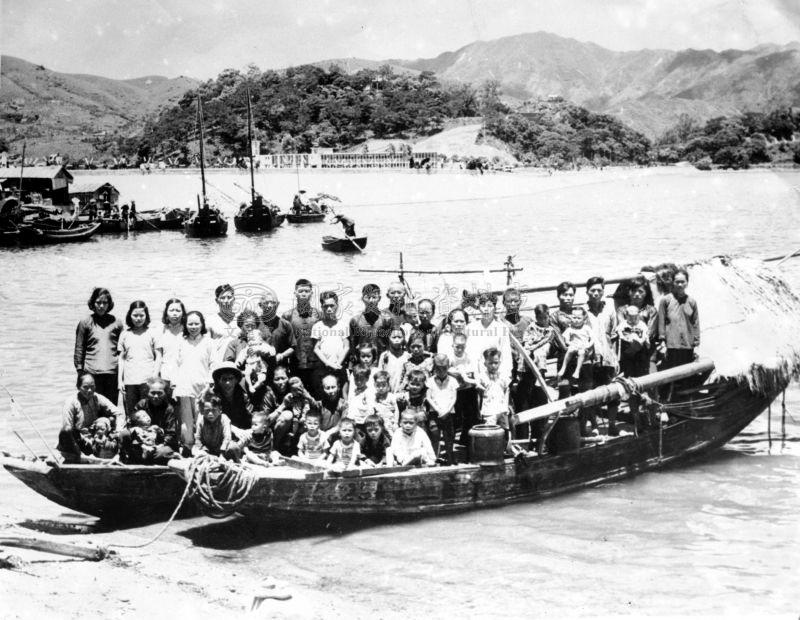
Fisherman Su Jiudai and three generations of his family, forty-eight people in total, arriving on the shores of Hong Kong after escaping overnight from Huiyang, Guangdong on four wooden sampans during the Great Famine.
The third wave peaked in the early 1970s. These were not illiterate peasants. These were the "Sent-Down Youths" (上山下乡的知青): educated urban students who had been exiled to remote villages by Mao Zedong to labor in the fields. Realizing they had been used as pawns in the Cultural Revolution and stripped of their futures, thousands made their way south. They trained for months to build physical endurance. They memorized the tides of Mirs Bay. They strapped inflated tractor tire tubes and plastic basketball bladders to their chests. They swam for eight, nine, ten hours through freezing water, under the sweep of searchlights and patrol gunboats. Hundreds drowned. Hundreds more were torn apart by sharks. Bodies washed ashore on the Hong Kong coastline almost daily.
The fourth wave came in 1979, just before Deng Xiaoping's economic reforms began to take effect. People ran because they had learned from thirty years of history: a regime that changes its mind once will change its mind again.
When you look at those four waves, you see the exact mirror of today. The people swimming Shenzhen Bay in 1972 were not counterrevolutionaries. They were simply young people who refused to waste their youth in ideological captivity. The people packing their bags in 2024 are their direct spiritual descendants. The tools have changed: instead of tractor inner tubes, they use student visas, investment schemes, and tourist routes through third countries. The geography has expanded: instead of Hong Kong, it is Chiang Mai, Tokyo, Lisbon, and Mexico. But the underlying arithmetic has not shifted by a millimeter. When survival inside the system requires you to swallow poison, the only rational response is to cross the border.
4IV. Walking the Jungle: The Middle Class in the Darien
If the flight of the wealthy to Tokyo and London is understandable, the most shocking phenomenon of the post-pandemic era is the journey known as *Zǒuxiàn* (走线): literally, "walking the line."
For decades, undocumented border crossings into the United States were associated with poor rural migrants from specific coastal counties in Fujian or Guangdong. Between 2022 and 2024, that demographic completely transformed.
Tens of thousands of Chinese citizens began flying halfway around the world to Quito, Ecuador, because Ecuador offered visa-free entry to Chinese passport holders. From Quito, they traveled by bus, boat, and foot through Colombia, into the notorious Darien Gap: sixty miles of roadless, mountainous rainforest separating South America from Central America.
The Darien Gap is one of the most perilous jungle crossings on earth. It is controlled by drug cartels and human traffickers. Migrants wade through waist-deep mud, cross rushing rivers where people regularly drown, and sleep on jungle floors under torrential rain. They face tropical disease, armed robbery, and extortion at every border checkpoint through Panama, Costa Rica, Nicaragua, Honduras, Guatemala, and Mexico.
And who were the people walking this route? Journalists who interviewed migrants along the trail found thirty-five-year-old software engineers laid off by Alibaba and Tencent. They found private school tutors whose entire industry was wiped out overnight by the central government's "Double Reduction" decree in July 2021. They found small business owners who had sunk their life savings into restaurants and shops, only to have their doors padlocked by local epidemic task forces for months on end. They found Christians whose unregistered churches were bulldozed, and young mothers carrying toddlers on their backs.
Consider what this requires. A person who had lived in an air-conditioned apartment with high-speed internet, who ordered dinner through an app and drank lattes on their way to work, decided that walking through eighty miles of predator-infested jungle was preferable to spending another year living under the Chinese Communist Party.
A regime that claims to represent the pinnacle of modern governance has produced citizens who would rather risk their lives in the mud of Central America than remain in their homeland. That is not a statistic a government can erase with a foreign ministry briefing. It is an indelible historic indictment written in muddy footprints across two continents.
5V. "We Are the Last Generation"
The quiet migration is not merely physical; it is biological. For those who cannot leave, the migration turns inward.
In May 2022, during the height of the Shanghai lockdown, an audio recording circulated across Chinese social media before the censors managed to scrub it.4 A young man was standing in the doorway of his apartment. Several police officers in hazmat suits were demanding that he leave his home and be taken to a quarantine facility, even though his test results were negative. The man refused. The leading officer pointed at him and delivered the standard state threat: *"If you refuse to obey the municipal government's order, you will be punished according to law. This penalty will go on your permanent record, and it will affect three generations of your family."*
Under the traditional Chinese system of collective punishment, this was the ultimate weapon. It meant your children would be barred from public service, barred from entering universities, and stripped of career opportunities. For decades, that single threat had brought the most defiant citizens to their knees.
The young man looked at the officer and replied, in a quiet, completely even voice: *"Thank you. But we are the last generation."* (谢谢,我们是最后一代。)
Those seven words landed with the force of an earthquake. It was not a threat of revolution. It was something far more terrifying to an authoritarian state: it was an announcement of non-cooperation at the most fundamental biological level.
Totalitarian systems do not merely require obedience today; they require human fuel for tomorrow. They need children to fill their military ranks. They need children to buy their state-subsidized apartments. They need children to pay into pension funds that local governments have already emptied.
When a population decides that bringing a child into the world is an act of cruelty because that child will merely inherit the status of a hostage, the state has lost its ultimate leverage.
The demographic numbers confirm what that young man said. In 2016, following the abolition of the one-child policy, nearly eighteen million babies were born in China. By 2023, that number had collapsed to just over nine million. The birth rate has fallen to levels lower than during the height of the Great Famine. Young people have coined another term: *Tǎngpíng* (躺平), to lie flat. Refuse the ninety-nine-six work schedule. Refuse the thirty-year mortgage. Refuse the marriage certificate. Refuse the cradle.
If *Rùn* is the migration across geographical borders, *Tǎngpíng* is the internal migration across the borders of the mind. Both spring from the exact same discovery: that the game is rigged, that the promises are fraudulent, and that the only way to win is to stop playing.
6VI. The Iron Cage Closes: Exit Bans and National Security
The state is not blind to what is happening. Its response has not been to reform, to listen, or to offer genuine legal protections. Its response has been to weld the exit doors shut.
For decades, Hong Kong served as the estate's decompression valve. If you could not breathe on the mainland, you moved your money and your life to Hong Kong. You had British common law, an independent judiciary, a free press, and an open financial system. With the imposition of the National Security Law in June 2020 and the passage of the Safeguarding National Security Ordinance (Article 23) in March 2024, that decompression valve was deliberately destroyed.5 Independent newspapers like *Apple Daily* and *Stand News* were shuttered. Journalists and opposition politicians were imprisoned without bail. Libraries purged books on the 1989 democracy movement. The border between Shenzhen and Hong Kong became an internal administrative boundary between two surveillance zones.
Meanwhile, on the mainland, the perimeter controls have tightened with clinical precision:
1. **Passport Confiscation**: Over the past four years, the requirement to surrender passports to state employers has expanded exponentially. It began with senior officials and military personnel. It spread to bank employees and mid-level bureaucrats. Today, in many provinces, ordinary public schoolteachers, university lecturers, and hospital nurses are required to hand their passports over to HR departments. If they wish to travel abroad for personal reasons, they must submit written applications detailing their itinerary, which are routinely denied. 2. **The Weaponization of Exit Bans**: Under expanded counter-espionage and data security laws, state security organs can place any individual on a "border control" (边控) list without court proceedings, without formal criminal charges, and without notification. Thousands of Chinese citizens, foreign business executives, and diaspora family members arrive at airport immigration counters only to be told they are forbidden from leaving "for reasons of national security."
The state wants the capital. It wants the labor. It wants the biological continuity. And it is turning the nation into a gated compound with digital facial-recognition turnstiles at every perimeter gate.
7VII. The Verdict of the Empty Stage
In 1917, when the Russian front collapsed, Vladimir Lenin noted that the soldiers were deserting not because they were convinced Bolsheviks, but because they simply refused to die for the Tsar. He wrote: *"They voted with their feet."*
Totalitarian regimes always suffer from the same optical illusion. Because they control all television channels, all newspapers, all search engines, and all street corners, they believe they have achieved total consensus. They look out at the parade square and see thousands of people waving identical red plastic flags and chanting identical slogans. They believe they are loved.
They fail to understand that performance under coercion is not consent. It is simply the price of admission to an environment where honesty is suicidal.
The quiet migration is the refutation of that illusion. It is happening without banners. It is happening without speeches. It is happening in embassy waiting rooms, in international airport departure halls, in cargo containers, and along jungle rivers.
Every family that sells its assets and leaves is delivering a verdict on the system that ruled them. They are saying: *You can keep the parades.* *You can keep the high-speed trains.* *You can keep the five-year plans and the red slogans.* *We do not believe your promises.* *We do not trust your banks.* *We will not surrender our children to your classrooms.*
A regime can build walls. It can confiscate passports. It can deploy drones and write national security laws. What it cannot do is compel a human heart to place its hopes in a lie.
The people who run are not abandoning their homeland because they despise their culture, their language, or their ancestors. They are leaving precisely because they want to preserve their humanity, their dignity, and their sanity. They are leaving the emperor on his platform, surrounded by guards and microphones, reciting his victories to an empty room.