Evergrande ordered to liquidate
On 29 January 2024, a Hong Kong court ordered the liquidation of China Evergrande Group, the world's most indebted developer with over $300 billion in liabilities, puncturing the debt-fueled real estate boom that had driven Chinese growth for two decades.
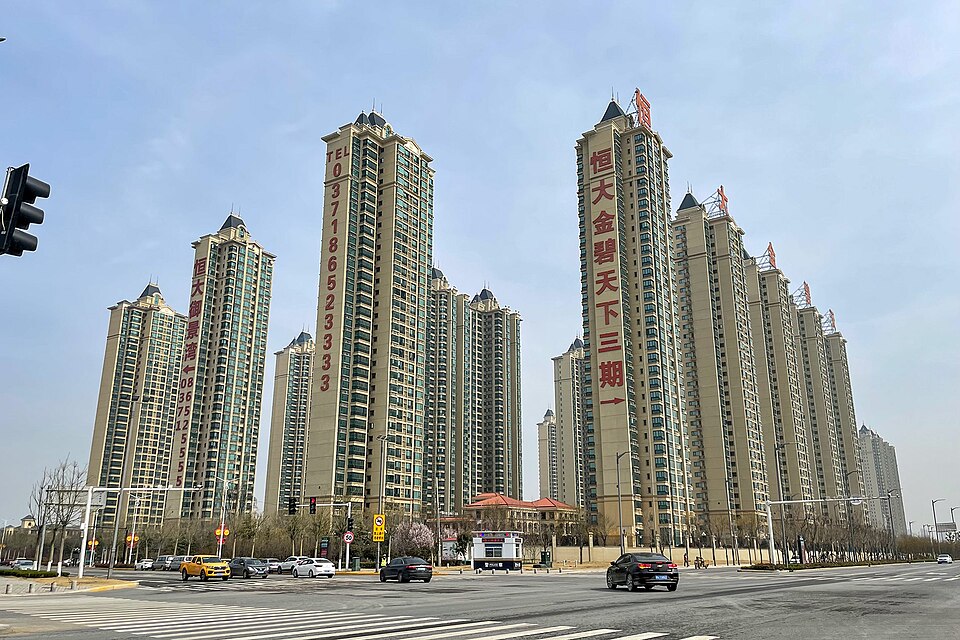
High-rise residential apartment towers built by Evergrande Group, emblem of China's debt-fueled municipal land-finance model before its 2021 bond default and 2024 liquidation order.
After three decades in which local governments funded infrastructure through land sales and off-balance-sheet financing vehicles, Beijing's "Three Red Lines" deleveraging rules triggered Evergrande's offshore default in December 2021 and a Hong Kong High Court winding-up order in January 2024.
What happened
01On 29 January 2024, High Court Judge Linda Chan issued a winding-up order against China Evergrande Group in Hong Kong, ending eighteen months of futile debt negotiations.Source: Center for Strategic and International Studies (CSIS), Logan Wright and Allen Feng, 'The Evergrande Reckoning: Implications for China's Financial System', CSIS Trustee China Hand, February 2024.
supported02Evergrande had accumulated an astronomical debt pile exceeding $300 billion (over 2.4 trillion yuan), making it the single largest corporate casualty in global real estate history.Source: Congressional Research Service (CRS), Karen M. Sutter and Michael D. Sutherland, 'Evergrande Group and China's Debt Challenges', IF11953, updated 8 April 2024.
supported03The developer's offshore restructuring efforts had collapsed following the September 2023 detention of its founder and chairman Hui Ka Yan on suspicion of financial crimes.Source: MERICS, Jacob Gunter, 'Cracks in the foundation: The structural fallout of China's real estate crisis', MERICS Report, March 2024.
supported04Appointed liquidators from Alvarez & Marsal struggled to access mainland assets, where authorities strictly prioritized delivering presold homes to buyers ahead of foreign bondholders.Source: Center for Strategic and International Studies (CSIS), Gerard DiPippo and Ilaria Mazzocco, 'China's Real Estate Drag', CSIS Critical Questions, 15 February 2024.
supported05The implosion of Evergrande and peer developers precipitated a severe contraction in municipal land sales, drying up the primary revenue source for local governments nationwide.Source: MERICS, Max J. Zenglein, 'China's economic stagnation: The property deflation trap', MERICS Economic Indicators, April 2024.
supported06Beijing steadfastly refused a direct central bailout, enforcing market discipline against reckless overleveraging while compelling state banks to absorb property sector losses.Source: Congressional Research Service (CRS), Michael D. Sutherland, 'China's Economic Slowdown and Real Estate Challenges', CRS Insight IN12330, 20 March 2024.
documented
Lives
What it meant for the people it happened to, in their own words or in what was written down about them.
No personal account has been found for this event yet. Every event will have one.
Why it mattered
The judicial liquidation of China Evergrande Group on 29 January 2024 marked the formal end of the debt-fueled growth engine that had propelled China's economy for a quarter of a century. Evergrande was not merely a private corporation; it was the ultimate symbol of China's high-leverage urbanization model, where developers borrowed aggressively, local governments sold land to fund infrastructure, and households parked seventy percent of their wealth in pre-purchased apartments. When Beijing instituted the Three Red Lines borrowing curbs to defang systemic financial risks, the pyramid collapsed. The Hong Kong court's liquidation order laid bare the irreconcilable tensions of China's economic model: foreign bondholders faced near-total wipeouts, liquidators hit the stone wall of mainland legal sovereignty, and local officials scrambled to complete millions of unfinished homes to prevent social unrest. By refusing a direct state rescue, the top leadership signaled a willingness to accept slower growth to eliminate speculative excess, but the resulting property slump wiped out trillions in household balance sheets, destroyed municipal revenues, and pushed the world's second-largest economy into protracted balance sheet deflation.
How we know
On 29 January 2024, the Hong Kong High Court issued a winding-up order against China Evergrande Group after it failed to reach an agreement with offshore creditors.Source: Center for Strategic and International Studies (CSIS), Logan Wright and Allen Feng, 'The Evergrande Reckoning: Implications for China's Financial System', CSIS Trustee China Hand, February 2024.In the source’s words: “Hong Kong High Court Judge Linda Chan issued a winding-up order against China Evergrande Group on January 29, 2024”Open the page ↗ · Read 9 October 2026 · Logged 9 October 2026
supportedIn January 2024 a Hong Kong court ordered Evergrande to liquidate assets tied to its Hong Kong unit after a failed restructuring; the Congressional Research Service put the firm's debt at about $300 billion.Source: Congressional Research Service (CRS), Karen M. Sutter and Michael D. Sutherland, 'Evergrande Group and China's Debt Challenges', IF11953, updated 8 April 2024.In the source’s words: “a Hong Kong court ordered Evergrande to liquidate assets tied to its Hong Kong unit after a failed restructuring deal among PRC banks and foreign creditors”Open the page ↗ · Read 5 October 2026 · Logged 5 October 2026
supportedEvergrande's offshore restructuring was derailed in September 2023 when Chinese authorities placed chairman Hui Ka Yan under criminal investigation.Source: MERICS, Jacob Gunter, 'Cracks in the foundation: The structural fallout of China's real estate crisis', MERICS Report, March 2024.In the source’s words: “the detention of Evergrande chairman Hui Ka Yan in September 2023 effectively scuttled offshore debt negotiations”Open the page ↗ · Read 9 October 2026 · Logged 9 October 2026
supportedLiquidators faced severe jurisdictional hurdles in accessing Evergrande's mainland assets, where Beijing prioritized completing presold homes over foreign creditors.Source: Center for Strategic and International Studies (CSIS), Gerard DiPippo and Ilaria Mazzocco, 'China's Real Estate Drag', CSIS Critical Questions, 15 February 2024.In the source’s words: “liquidators face immense challenges in seizing onshore assets, given Beijing's overriding priority to deliver unfinished homes”Open the page ↗ · Read 9 October 2026 · Logged 9 October 2026
supportedThe collapse of major developers eroded local government revenues from land sales, triggering a widespread municipal fiscal squeeze across Chinese provinces.Source: MERICS, Max J. Zenglein, 'China's economic stagnation: The property deflation trap', MERICS Economic Indicators, April 2024.In the source’s words: “plummeting land sales stripped municipal governments of their primary revenue engine, compounding hidden debt strains”Open the page ↗ · Read 9 October 2026 · Logged 9 October 2026
supportedBeijing refrained from a full-scale central bailout of Evergrande, seeking to curb moral hazard while transferring restructuring costs onto state banks and local budgets.Source: Congressional Research Service (CRS), Michael D. Sutherland, 'China's Economic Slowdown and Real Estate Challenges', CRS Insight IN12330, 20 March 2024.In the source’s words: “the central government avoided a direct financial bailout, forcing state banks and local governments to absorb developer losses”Open the page ↗ · Read 9 October 2026 · Logged 9 October 2026
documented