The retirement age raised
On 13 September 2024, China's legislature passed the first increase in the statutory retirement age in seventy years, raising male retirement to 63 and female retirement to 55 or 58, as the regime confronted an accelerating demographic deficit and depleting pension reserves.
The first change in about seventy years, phased in over fifteen years from January 2025.
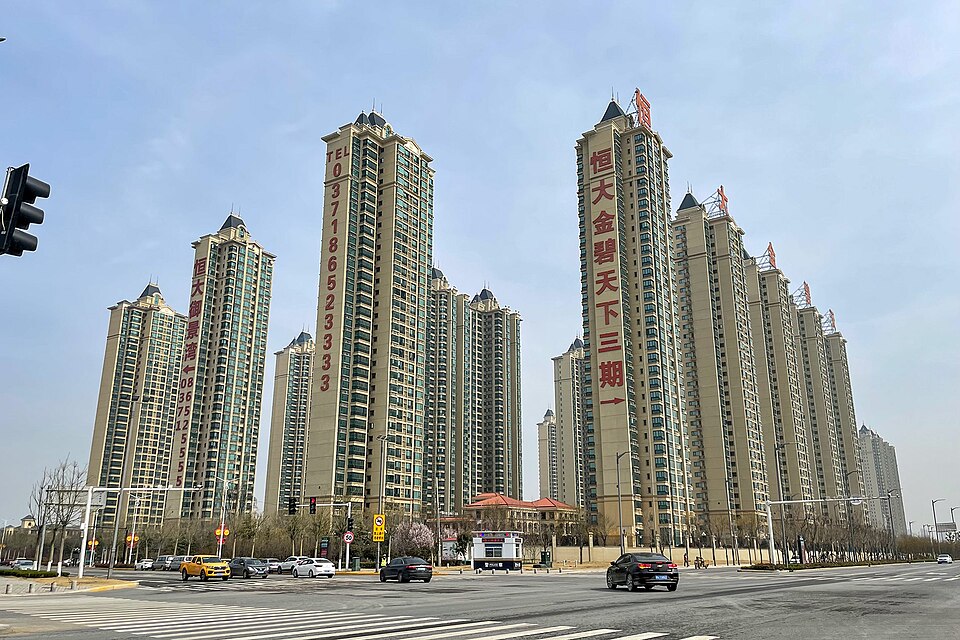
High-rise residential apartment towers built by Evergrande Group, emblem of China's debt-fueled municipal land-finance model before its 2021 bond default and 2024 liquidation order.
After three decades in which local governments funded infrastructure through land sales and off-balance-sheet financing vehicles, Beijing's "Three Red Lines" deleveraging rules triggered Evergrande's offshore default in December 2021 and a Hong Kong High Court winding-up order in January 2024.
What happened
01On 13 September 2024, the Standing Committee of the 14th National People's Congress adopted a landmark decision to raise the statutory retirement age gradually starting on 1 January 2025.Source: Congressional Research Service (CRS), Karen M. Sutter, 'China's Demographic Shift and Retirement Reform', CRS In Focus IF12760, 24 September 2024.
documented02The policy represented the first revision to China's retirement thresholds since the 1950s, phasing in increases over fifteen years to 63 for men and 55 or 58 for women depending on job classification.Source: MERICS, Christina Sadeler, 'Too little, too late? Demographic and structural challenges hobble China's pension system', 5 March 2025.
supported03The statutory decision also mandated raising the minimum contribution period for receiving basic urban pensions from 15 to 20 years starting in 2030.Source: Center for Strategic and International Studies (CSIS), Scott Kennedy and Ilaria Mazzocco, 'Working Longer: China Confronts Its Aging Crisis', CSIS Critical Questions, 17 September 2024.
supported04Official projections accelerated the reform, as research by the Chinese Academy of Social Sciences indicated the national urban pension pool could exhaust its accumulated surplus by 2035.Source: MERICS, Jacob Gunter, 'China's demographic crunch: Running out of workers before getting rich', MERICS Report, October 2024.
supported05The announcement ignited widespread frustration across social media, where young and middle-aged urban workers questioned paying into pensions longer amid severe job market competition.Source: Congressional Research Service (CRS), Michael D. Sutherland, 'Labor Market Strains and Public Backlash in China', CRS Insight IN12415, 8 October 2024.
documented06Demographers emphasized that raising the retirement threshold by a few years cannot bridge the enormous fiscal gap caused by plunging birth rates and the world's fastest-aging population.Source: Center for Strategic and International Studies (CSIS), Logan Wright, 'The Limits of Parametric Pension Reform in China', CSIS Trustee China Hand, November 2024.
supported
Lives
What it meant for the people it happened to, in their own words or in what was written down about them.
No personal account has been found for this event yet. Every event will have one.
Why it mattered
The statutory elevation of China's retirement age on 13 September 2024 was an unavoidable concession to a demographic arithmetic that no ideological campaign could rewrite. For seven decades, the Chinese state maintained an artificially low retirement age inherited from the Maoist era, when life expectancy was barely forty-five and state-owned enterprises absorbed surplus labor. By 2024, China had become the fastest-aging society in human history, with life expectancy exceeding seventy-eight, births falling to half the level of a decade earlier, and the primary pension fund projected to run dry by 2035. Yet the reform revealed deep generational inequities. Younger workers, already battered by staggering youth unemployment, grueling workplace hours, and collapsing housing values, were effectively told they must work longer, pay social security taxes for twenty years instead of fifteen, and accept diminished entitlements to support an unprecedented retiree boom. By passing the adjustment via an expedited legislative decree rather than open debate, Beijing managed to postpone the immediate bankruptcy of the pension system, but deepened the quiet disillusionment of an urban youth population increasingly opting out of marriage, childbearing, and economic ambition.
How we know
On 13 September 2024, the NPC Standing Committee formally approved raising the statutory retirement age starting January 2025.Source: Congressional Research Service (CRS), Karen M. Sutter, 'China's Demographic Shift and Retirement Reform', CRS In Focus IF12760, 24 September 2024.In the source’s words: “approved a plan to gradually raise the retirement age beginning in January 2025”Open the page ↗ · Read 9 October 2026 · Logged 9 October 2026
documentedIn September 2024 China adopted the first rise in its statutory retirement age in about seventy years, to 63 for men and 55 or 58 for women depending on profession, phased in over fifteen years.Source: MERICS, Christina Sadeler, 'Too little, too late? Demographic and structural challenges hobble China's pension system', 5 March 2025.In the source’s words: “the first adjustment in 70 years”Open the page ↗ · Read 5 October 2026 · Logged 5 October 2026
supportedThe reform also raised the minimum pension contribution requirement from 15 to 20 years starting in 2030.Source: Center for Strategic and International Studies (CSIS), Scott Kennedy and Ilaria Mazzocco, 'Working Longer: China Confronts Its Aging Crisis', CSIS Critical Questions, 17 September 2024.In the source’s words: “raised the minimum number of years workers must contribute to the pension system from 15 to 20 years”Open the page ↗ · Read 9 October 2026 · Logged 9 October 2026
supportedThe pension overhaul was accelerated by official projections that the urban pension reserve fund faced exhaustion by 2035 due to population contraction.Source: MERICS, Jacob Gunter, 'China's demographic crunch: Running out of workers before getting rich', MERICS Report, October 2024.In the source’s words: “projections indicating the urban employee pension fund could run out of accumulated reserves by 2035”Open the page ↗ · Read 9 October 2026 · Logged 9 October 2026
supportedThe measure triggered intense public frustration among younger workers coping with record youth unemployment and pervasive overtime work culture.Source: Congressional Research Service (CRS), Michael D. Sutherland, 'Labor Market Strains and Public Backlash in China', CRS Insight IN12415, 8 October 2024.In the source’s words: “the announcement met with widespread public discontent, especially among younger cohorts facing intense job competition”Open the page ↗ · Read 9 October 2026 · Logged 9 October 2026
documentedDemographic experts warned that modest increases in retirement ages cannot resolve the structural fiscal deficit caused by rapid aging and shrinking fertility.Source: Center for Strategic and International Studies (CSIS), Logan Wright, 'The Limits of Parametric Pension Reform in China', CSIS Trustee China Hand, November 2024.In the source’s words: “parametric adjustments alone cannot offset the structural imbalances of a rapidly shrinking workforce”Open the page ↗ · Read 9 October 2026 · Logged 9 October 2026
supported